
The obsessive, incremental, occasionally absurd evolution of the Ultra — from powered party trick to legitimate wave weapon.
Article by West Coast eFoil
There's a particular kind of madness that takes hold of engineers when surfers get involved. You see it in shapers who spend forty years chasing three millimetres of tail rocker. You see it in fin designers who'll talk about cant angle at dinner parties until the room clears. And you see it, unmistakably, in the team at Fliteboard — who have spent four consecutive model years shaving grams, shifting mass, and nudging a mast position forward by two centimetres in the pursuit of making a motorised hydrofoil feel like it doesn't have a motor at all.
The Ultra series is Fliteboard's flagship performance line. It is not, and has never been, a board for people who just want to cruise around the bay on a Sunday morning. It is a board for people who want to cruise around the bay on a Sunday morning, find a bump of swell, kill the throttle, drop into it, and pretend — convincingly — that they're prone foiling.
That last part is what changed. And how it changed, model by model, tells you a lot about where eFoiling is headed.
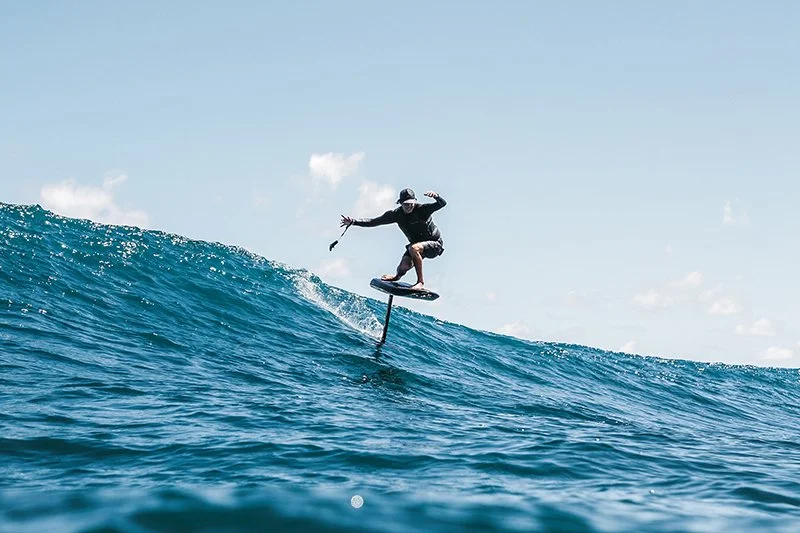
The Original Ultra: A Carbon-Wrapped Promise
The first Ultra arrived as Fliteboard's statement of intent for the performance end of the market. Carbon fibre and Innegra construction. Light. Responsive. The kind of board that made intermediate riders feel fast and advanced riders feel like they were finally on something worthy of their ability.
But let's be honest about what it was: it was a very good powered eFoil. The mast position was optimised for what eFoils do most of the time — fly under motor power. Footstraps were available. Handles were there for carrying it down to the water. It was a performance board in the way a sports car is a performance car: exciting, capable, and firmly tethered to its engine.
What Fliteboard had done, though, was create the architecture. The modular system — swappable batteries, interchangeable wings, prop-or-jet options — meant the Ultra wasn't a finished product. It was a platform. A starting point. The company just hadn't said the quiet part out loud yet: they wanted to build a surf foil with a battery in it.
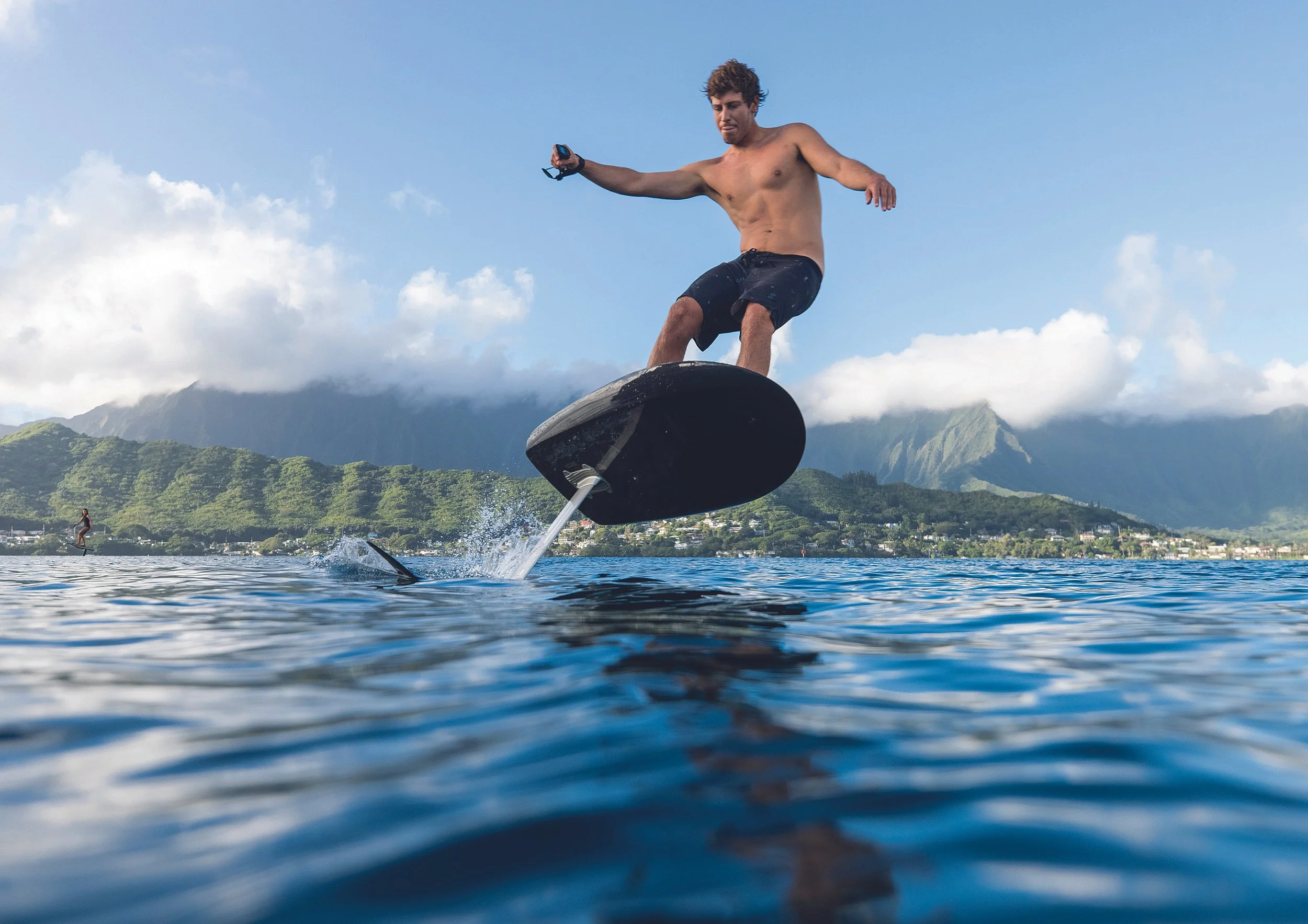
Ultra L (2023): Stripping Down
The "L" stands for Light, though Fliteboard CEO David Trewern joked it meant "Life Changing" when the board launched alongside the Series 3.
The Ultra L shared the same dimensions and volume as the original Ultra, but the approach was surgical: lose weight, everywhere, by any means that don't compromise the ride. The footstraps went. The carry handles went. The battery box was rebuilt in hand-laid carbon fibre. The result was a complete setup weighing 22.5 kilograms with the new Flitecell Nano battery — making it the lightest performance eFoil you could buy in 2023.
But the real insight wasn't about total weight. It was about swing weight. Trewern explained the philosophy at the time: they hadn't just reduced the weight, they'd repositioned the battery mass as close to the mast as possible, tightening the rotational inertia of the whole system. On paper, it's an engineering concept. On the water, it's the difference between a board that pivots when you lean and a board that lags.
The Ultra L didn't change the mast position. It didn't need to. What it did was prove that weight distribution — where the mass sits relative to the foil — matters as much as, if not more than, the mast's physical location on the board. It was the first Ultra that made experienced riders think: this thing could actually work in waves.
And it did. Tested at The Pass in Byron Bay on clean, overhead right-handers, the Ultra L with the Nano battery and the prototype folding prop was, by all accounts, a revelation. The “foldy” — which collapses flat when you release the throttle — meant riders could shut down the motor and glide into a wave with minimal drag.
The gold colourway, incidentally, was divisive. Rumours in the Flite community suggested the new anodising was designed to appeal to the burgeoning Dubai market, where clients were requesting “gold efoils”. Apparently one client in the UAE had a garage full of gold-hued water toys. He wanted to add a Fliteboard to the collection.
We digress … Regardless of the bling factor, performance has a way of settling aesthetic arguments. And this was the market’s best and lightest lithium joy stick.
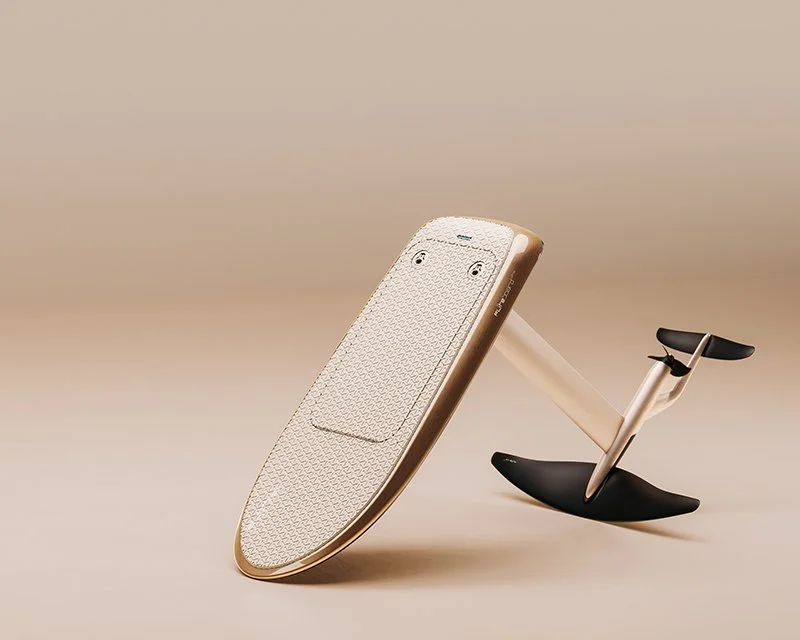
Ultra L2 (2024): The Shape Shifts
If the Ultra L was the original Ultra on Ozempic, the Ultra L2 was an entirely new creature.
The dimensions changed: narrower outline, slightly longer, pulled down to 49 litres. At 4'4" by 21 inches, it was closer in form to a prone foil board than anything Fliteboard had built before. The carbon Innegra construction was retained, and the total system weight with the Nano battery held at a staggering 18 kilograms. For context, that's similar to the weight of some of the earliest foil setups that came without a motor.
The critical design move on the L2 was the battery box. Fliteboard redesigned it and centred it directly over the mast, pulling the heaviest component of the system — the battery — into perfect alignment with the pivot point of the foil below. This reduced swing weight further and created what riders described as a more balanced feel when pumping and transitioning through turns.
The board was paired with the Marc Newson-designed Wave eFoil system: an 82-centimetre carbon monocoque mast with an impossibly slim 46-millimetre fuselage and a propulsion system just 40 millimetres in diameter — the world's smallest eFoil motor housing. The monobloc construction eliminated joints and bolts between mast, fuselage, and tail, cutting drag and adding torsional stiffness.
The Ultra L2 worked. Properly worked. In waves, with the folding prop collapsed and the motor silent, it carved. It pumped. It slid around sections. The Foiling Magazine's tester called it a "powerfully good time packed into 18.3 kilograms of kit" and noted the lack of drag was "immediately noticeable."
But there was a tell. Experienced wave riders — the ones who'd spent years on prone foils and knew exactly what a surf foil should feel like — noticed that when they killed the power and dropped into a wave, they had to stay busy with their feet. The pitch management required constant attention. Small weight shifts made big differences. Miss the timing on a pitch correction and you'd either nose-drop or breach.
The mast was still sitting slightly too far back for pure wave performance. Under power, that position was fine — maybe even ideal. But the moment you went unpowered, the board revealed its heritage as a motorised craft.
Two centimetres. That was the gap between "very good eFoil in waves" and "surf foil with a motor."
Ultra L3 (2026): The Two-Centimetre Revolution
Fliteboard didn't reinvent the Ultra for 2026. They moved the mast forward by two centimetres and added a tail kicker. That's essentially it. Aquamarine indicated this was another evolution, rather than revolution. But the difference on unpowered waves was huge..
The forward mast position on the Ultra L3 rebalances the entire board-foil relationship for what happens after you let go of the trigger. On the earlier Ultras, the mast sat in a position that prioritised powered stability. The L3 moves that connection point forward to prioritise pitch stability during the critical transition from powered to unpowered flight — the exact moment when you drop into a wave and the motor goes quiet.
What riders feel is this: the board settles. Where earlier Ultras would hunt — requiring constant micro-corrections to manage pitch at low and mid speeds — the L3 finds a natural equilibrium. You come off the throttle, the prop folds, and instead of fighting the board to stay in the pocket, you're reading the wave. The foil carries speed. Turns connect. You're closer to the feeling of surfing.
The integrated tail kicker gives your back foot a physical platform to push against during hard carves and cutbacks — the same functional role a kick tail serves on a conventional surfboard or prone foil board. Combined with the forward mast, it allows deeper rail-to-rail transitions without the board catching or losing composure.
The numbers: 49 litres. Just 46 millimetres of fuselage width. System weight of 18 kilograms with the Nano. Pre-configured with the MN Carbon Wave 82-centimetre mast and folding prop. Compatible with the Flux conical wing range — the 707, 808, and 1010 — all designed to maximise glide and performance in waves.
One of the first riders to test the updated board summarised it with a line that would make any shaper's heart sing: "This is the first Ultra that actually feels easier in waves without feeling slower or less alive."
That's the trick. Moving the mast forward calms the board down, but it doesn't dull it. The L3 is still hyper-responsive, still rewards aggressive riding, still feels alive under your feet. It's just that the life in it is now directed at the wave, not at fighting the physics of a motor hanging off the back.

What Changed, and What It Means
Lay the four boards side by side and the evolution is clear:
Ultra — A performance eFoil. Optimised for powered riding. Exciting under motor, functional in waves if you worked at it. Footstraps and handles. The foundation.
Ultra L — The same board, stripped. Battery repositioned closer to the mast. Swing weight reduced. The first time an eFoil felt genuinely light enough to surf. No change to mast position, but a proof of concept: weight distribution is everything.
Ultra L2 — New shape. Narrower, longer, lower volume. Battery box centred directly over the mast. The board reshaped around the foil's pivot point. System weight down to 18 kilograms. Brilliant in waves, but the mast position still favoured powered riding.
Ultra L3 — Mast moved 2 centimetres forward. Tail kicker added. The board now optimised for what happens after the motor stops. Pitch stability in unpowered flight. The first Ultra that prioritises the wave over the engine.
Four years. Four boards. And the defining change — the one that made the biggest difference to how the board actually rides in surf — was a mast shift you could measure with your thumb.
That's not a criticism. That's the point. Anyone can make a radical change. It takes genuine understanding to make the right small one. Fliteboard didn't chase a revolution with the Ultra series. They iterated, obsessively, toward a vision that was always there in the background: an eFoil that a surfer would choose to ride in waves not because it has a motor, but despite it.
The Ultra L3, at its best, makes you forget the motor is there. Which is exactly the kind of madness that happens when engineers listen to waveriders. Or better still, are wave slaves themselves.
West Coast eFoil is a Perth-based eFoil retailer and experience provider. For more information on the Fliteboard Ultra range, visit westcoastefoil.com